Thursday, 22 November 2012


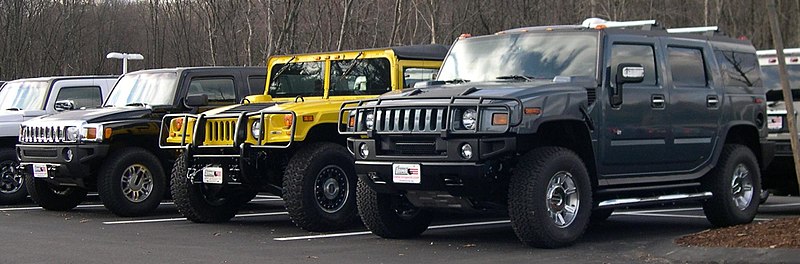
Hummer was a brand of trucks and SUVs, first marketed in 1992 when AM General began selling a civilian version of the M998 Humvee. In 1998, General Motors (GM) purchased the brand name and marketed three vehicles: the original Hummer H1, based on the Humvee; and the H2 and H3 models that were based on smaller, civilian-market GM platforms.
By 2008, Hummer's viability in the economic downturn was being questioned, and it was placed under review by GM management. Rather than being transferred to Motors Liquidation Company as part of the GM bankruptcy in 2009, the brand was retained by GM, in order to investigate its sale.
In 2009, a Chinese manufacturer, Sichuan Tengzhong Heavy Industrial Machinery Company, announced that it would acquire Hummer, pending government approvals, but later withdrew its bid.On February 24, 2010, Reuters reported that the Chinese ministry of commerce had prevented the deal, although a ministry spokesperson denied rejecting the application, which had been stalled for eight months. At the end of February, General Motors announced it would begin dismantling the Hummer brand.
Although the automaker announced two days later that it had been approached with new offers,by April 2010, any sale became unlikely, as inventory was depleted and Hummer dealerships began shutting down. After filling a rental-car fleet order, the last Hummer H3 rolled off the line at Shreveport on May 24, 2010.

Origin:

The original Hummers were first designed and built by AM General Corporation, which was formerly AMC-Jeep's General Products division, in its Mishawaka, Indiana, assembly plant. The vehicles were created under a contract for the United States armed forces. The first model, the Humvee, was built in a variety of military-based equipment and versions. The US$1.2 billion contract won by AM General in 1983 was to produce 55,000 Humvees by 1985, which was later increased by 15,000 additional units.
AM General had planned to sell a civilian version of the Humvee as far back as the late 1980s. Having the same structure and most mechanical components, the civilian Hummers were finished in automotive gloss paint, adding passenger car enhancements such as air conditioning, sound insulation, upgraded upholstery, stereo systems, wood trim, and convenience packages.The civilian model began in part because of the persistence of Arnold Schwarzenegger, who saw an Army convoy while filming a movie.
In 1990, two matching white Humvees were driven from London to Beijing over the rough roads of central Soviet Union. The Hummers made the trip with ease, for they were built to drive on off-road terrain. The highlights of this journey were broadcast in the United States on ESPN. This publicity would pale in comparison to the attention that the Humvee received for its service in Gulf War Operation: Desert Storm, the following year.Also, a privately-owned Humvee was modified into the first Snow-Vee, including the addition of caterpillar tracks, a new rear compartment and a new engine. This vehicle was designed for use in and just below the Arctic Circle, and the Antarctic.
In 1992, AM General began selling a civilian version of the M998 Humvee vehicle to the public under the brand name "Hummer".

GM Purchase:

In December 1999, AM General sold the brand name to General Motors, but continued to manufacture the vehicles.GM was responsible for the marketing and distribution of all Hummers produced by AM General. Shortly thereafter, GM introduced two of its own design models, the H2 and H3, and renamed the original vehicle H1. AM General continued to build the H1 until it was discontinued in 2006,and was contracted by GM to produce the H2. The H3 was built in Shreveport, LA alongside the Chevrolet Colorado and GMC Canyon pickups, with which it shared the GMT-355 platform (modified and designated GMT-345). Hummer dealership buildings featured an over sized half Quonset Hut style roof, themed to the Hummer brand's military origins.
By 2006, the Hummer began to be exported and sold through importers and distributors in 33 countries.On October 10, 2006, GM began producing the Hummer H3 at its Port Elizabeth plant in South Africa for international markets.The Hummers built there at first were only left-hand drive, but right-hand drive versions were added and exported to Australia and other markets.
The H2 was also assembled in Kaliningrad, Russia, by Avtotor, starting in 2006 and ending in 2009. The plant produced a few hundred vehicles annually, and its output was limited to local consumption with five dealers in Russia.
On June 3, 2008, one day prior to GM's annual shareholder meeting, Rick Wagoner, GM's CEO at that time, said the brand was being reviewed, and had the possibility of either being sold, having the production line completely redesigned, or being discontinued.This was due to the decreasing demand for large SUVs as a result of higher oil prices. Almost immediately after the announcement, a pair of Indian automakers, including Mahindra & Mahindra, expressed interest in purchasing all or part of Hummer.
GM President Fritz Henderson stated several interested parties approached GM regarding the Hummer business. On April 5, 2009, Société de Participation Financière Eidos Canada Inc. (Eidos) made an unsolicited bid for Hummer.

Models:

Hummer H1:

The first vehicle in the Hummer range was the Hummer H1, based on the Humvee.
Originally released in 1992, this vehicle was designed by American Motors' AM General subsidiary for the U.S. Military.
Five years previously, AMC had been bought by Chrysler.


Hummer H2:

The Hummer H2 was the second vehicle in the Hummer range. There were two variations: The H2 SUV and H2 SUT..


Hummer H3:

The H3 and H3T truck were the smallest of the Hummer models and were based on the GMT355 platform shared with the Chevrolet Colorado and GMC Canyon compact pickup trucks.


Hummer concept car:

The Hummer HX was developed in 2008 as an open-air, two-door off-road concept car, smaller than other Hummer models.


Nissan 350z


The Nissan 350Z (known as Nissan Fairlady Z Z33 in Japan) is a two seat sports car that was manufactured by Nissan from 2003 to 2009 and marks the fifth generation (codename: Z33) of Nissan's Z-car line.The 350Z entered production in late 2002 and was sold and marketed as a 2003 model. The first year there was only a coupe, as the roadster did not debut until the following year.
Initially, the coupe came in base, Enthusiast, Performance, Touring and Track versions, while the roadster was limited to Enthusiast and Touring trim levels. The Track trim came with lightweight wheels and Brembo brakes, but its suspension tuning was the same as all other coupes.The Nissan 350Z has been succeeded by the 370Z for the 2009 model year.

PREPRODUCTION MODELS:
240z concept(1999):

Nissan unveiled the 240Z concept car at the 1999 North American International Auto Show, then later at the Los Angeles Auto Expo.
The concept was designed by Ajay Panchal of Nissan's California design studio. Clearly a throwback to the original, it was a bright orange two-seater with classic swept-back styling. In addition, it was fully functional, with the 2.4-liter 4-cylinder KA24DE engine from the Nissan Altima featuring 200 bhp (150 kW) and 180 lb·ft (244 N·m) of torque. The designers used an original 240Z to provide inspiration and the concept was created in only 12 weeks.
 Unfortunately critics said "it would be cool but get a new model."
The running concept, featuring a 4-cylinder engine compared to the Z-car's traditional 6-cylinder engine, was eventually thought a less than a worthy successor to the line.

SPECIAL EDITIONS:
TYPE E (2004):


A limited run (only 5 units) called the Type E was produced in Japan in order to meet homologation requirements to compete in the Super GT series. The Type-E featured a longer nose and rear overhang as well as a few extra aerodynamic aids.
Engine is rated at 206 kW (280 PS) @ 6200 rpm, 363 N·m (37.0 kgf·m) @ 4800 rpm.

NISMO EDITIONS:
Police edition:

A NISMO version of the Z33 was also used by Tochigi Prefecture police force.

NISMO 350Z (2007–2008):


This edition of the 350Z Coupé debuted in New York International Auto Show on 2007-04-04. This version featured the same engine as the regular 350Z (VQ35HR) with 6-speed manual transmission only. The car featured NISMO aerodynamics package based on the Super GT championship car, which included an aggressive front fascia with chin spoiler, side skirts, an extended rear fascia with under body diffuser and a rear wing. The car also had NISMO-tuned independent multi-link suspension, Brembo brakes with four-piston front and two-piston rear calipers (with 12.8-inch (330 mm) front and 12.7-inch (320 mm) rear rotors) and NISMO-branded gunmetal grey RAYS alloy wheels (18x9-inch front and 19x10-inch rear with 245/40WR18 front, 265/35WR19 rear Bridgestone Potenza RE050A tires), and NISMO-branded tuned exhaust. All Nismo versions are "Ready For Track" with the safety equipment in it.
The NISMO 350Z went on sale in the USA in July 2007 at Nissan dealers. 1607 were produced for the 2007 and 2008 model years, and it was assumed that if there was a greater demand, more would be produced, limited to 10% of all 350Z sales. The NISMO model 350Z had a manufacturer's suggested retail price of $38,070 for the 2007 model year.

Wednesday, 21 November 2012

LANCER EVOLUTION (Facts and Specs)


The Mitsubishi Lancer Evolution, colloquially known as the Lancer Evo or evo, is a high-performance sedan manufactured by Mitsubishi Motors. There have been ten official versions to date, and the designation of each model is most commonly a roman numeral. All use two litre, turbocharged engines and four-wheel drive systems.
The Evolution was originally intended only for Japanese markets, but demand on the "grey import" market led the Evolution series to be offered through Ralliart dealer networks in the United Kingdom and in various European markets from around 1998. Mitsubishi decided to export the eighth generation Evolution to the United States in 2003 after witnessing the success Subaru had in that market with theirImpreza WRX, a direct competitor in other global regions.
Japanese-spec cars were limited by a gentlemen's agreement to advertise no more than 280 PS (206 kW; 276 hp), a mark already reached by Evolution IV. Therefore, each subsequent version has unofficially evolved above the advertised power figures, with the Japanese-spec Evolution IX reaching an alleged output of around 321 PS (236 kW; 317 hp). Various versions available in other markets, particularly the UK, have official power outputs up to 411 PS (302 kW; 405 hp).
The tenth generation of the Lancer Evolution was launched in Japan 2007, and overseas markets in 2008.

Evolution-I:(First Generation)

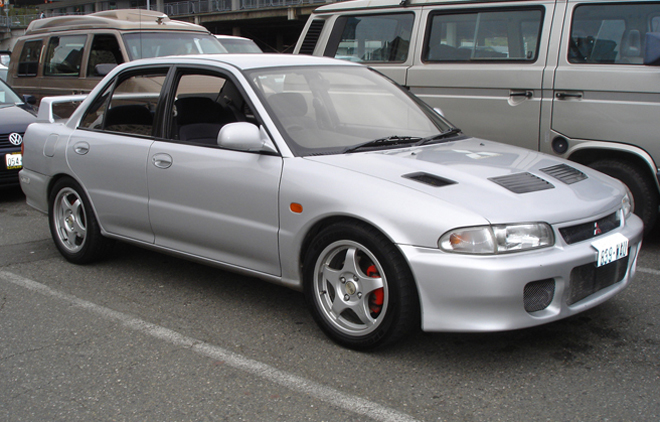
The original Lancer Evolution was to compete in the World Rally Championship. It used the 2.0 L turbocharged DOHC engine and 4WD drivetrain from the original Galant VR-4 in a Lancer chassis, and was sold in GSR and RS models. This engine was also used in the Mitsubishi RVR with the Hyper Sports Gear trim package. The RS was a stripped-down version that lacked power windows and seats, anti-lock brakes, a rear wiper, and had steel wheels to weigh approximately 70 kg (154 lb) less than the 1,238 kg (2,729 lb) GSR, ready for racing or tuning. The GSR came with all of the conveniences of a typical street car. It came with Mitsubishi's 4G63 engine producing 247 PS (182 kW; 244 hp) at 6000 rpm and 309 N·m (228 lb·ft) at 3000 rpm. 5,000 of the first generation Evolutions were sold between 1992 and 1993. Top speed was 228 km/hour (142 mph)!

Evolution-II:(Second Generation)

The Evolution II was upgraded in December 1993, and was produced until February 1995. 
It consisted mainly of handling improvements, including minor wheelbase adjustments, larger swaybars, bodywork tweaks including a larger spoiler, and tyres that were 10 mm (0.4 in) wider.
 This Evolution also has a 50 l (13.2 US gal; 11.0 imp gal) fuel tank. Power output was increased to 256 PS (188 kW; 252 hp) from the same engine and torque was unchanged for both GSR and RS models.


Evolution-III:(Third generation)

February 1995 saw the arrival of the Evolution 3, which had several improvements over the previous models.
 New, more aggressive styling and a new nose moulding improved the air supply to the radiator, intercooler and brakes.
 New side skirts and rear bumper moldings and a larger rear spoiler were added to reduce lift. 
Improved engine had higher compression ratio than before, and new turbocharger compressor (60 mm to 68 mm), which gave power output of 270 bhp (201 kW) at 6250 rpm, 309 N·m (228 lb·ft) at 3000 rpm.

February 1995 saw the arrival of the Evolution 3, which had several improvements over the previous models.
 New, more aggressive styling and a new nose moulding improved the air supply to the radiator, intercooler and brakes.
 New side skirts and rear bumper moldings and a larger rear spoiler were added to reduce lift. 
Improved engine had higher compression ratio than before, and new turbocharger compressor (60 mm to 68 mm), which gave power output of 270 bhp (201 kW) at 6250 rpm, 309 N·m (228 lb·ft) at 3000 rpm.

Evolution IV:(Fourth generation)

The Lancer platform was completely changed in 1996, and along with it the Evolution, which had become extremely popular throughout the world.
 The engine and transaxle was rotated 180° to better balance the weight and eliminate torque steer. There were two versions available, The RS and GSR.
 The RS version was produced as a competition car with a limited-slip front differential and a friction type LSD at the rear.
 It also came with GLX seats and a choice of either 16" or 17" OZ light weight racing wheels. The RS also had wind up windows, optional air conditioning in some models, and a few extra brace bars to strengthen the chassis, one behind the front grill and the other across the boot floor. The RS also had thinner body panels and glass.
 The GSR and the RS shared a new twin scroll turbocharger which helped to increase power to 280 PS (206 kW; 276 hp) at 6,500 rpm and 330 N·m (243 lb·ft) of torque at 4,000 rpm. Mitsubishi's new Active Yaw Control appeared as a factory option on the GSR model, which used steering, throttle input sensors and g sensors to computer-hydraulically control torque split individually to the rear wheels and as a result the 10000 Evolution IVs produced all sold quickly. The Evolution IV can be distinguished by its two large fog lights in the front bumper (option on RS version), and the newly designed tail lights on the rear, which became a standard design to Evolution V, which would become yet another trademark of the Evolution series.
 This new generation was slightly heavier than previous Evos—the GSR in particular due to the added technology systems—but to counter this the car produced even more power—the weight of the RS being 1,260 kg (2,778 lb) and the GSR being 1,345 kg (2,965 lb). Much of the technical improvements for this generation were also used in the second generation Mitsubishi RVR sold only in Japan.


Evolution-V:(Fifth Generation)

Many aspects of the car were changed such as:
The interior was upgraded in the GSR version with a better class of Recaro seat.
The body kit had flared arches at the front and rear and a new aluminium rear spoiler replaced the IV FRP version and gave an adjustable angle of attack to alter rear down force.
The track was widened by 10 mm (0.4 in), the wheel offset changed from ET45 to ET38 along with the wheel diameter which rose from 16" to 17" to accommodate Brembo brakes which were added to enhance braking.
In addition the brake master cylinder bore increased by 0.3 millimetres (0.01 in).
The engine was strengthened in a few areas and the cam duration was increased. 
The pistons were lighter with a smaller skirt area. 
510 cc injectors were replaced with 560 cc injectors for better engine reliability due to more electrical "headroom" and the ECU was changed to include a flash ROM, allowing more boost pressure to the same TD05-HR as the Mitsubishi Evolution III and IV.
Furthermore, the turbocharger was again improved. Torque was increased to 373 N·m (275 lb·ft) at 3000 rpm. 
Power officially stayed the same, at 280 PS (206 kW; 276 hp), though some claim horsepower was actually somewhat higher


Evolution-VI:(Sixth Generation)


The Evolution VI's changes mainly focused on cooling and engine durability. 
It received a larger intercooler, larger oil cooler, and new pistons, along with a titanium-aluminide turbine wheel for the RS model, which was a first in a production car.
 The Evolution VI received new bodywork yet again, with the most easily noticeable change being within the front bumper where the huge fog lights were reduced in size and moved to the corners for better airflow.
 A new model was added to the GSR and RS lineup; known as the RS2, it was an RS with a few of the GSR's options. Another limited-edition RS was known as the RS Sprint, an RS tuned by Ralliart in the UK to be lighter and more powerful with 330 hp (246 kW).
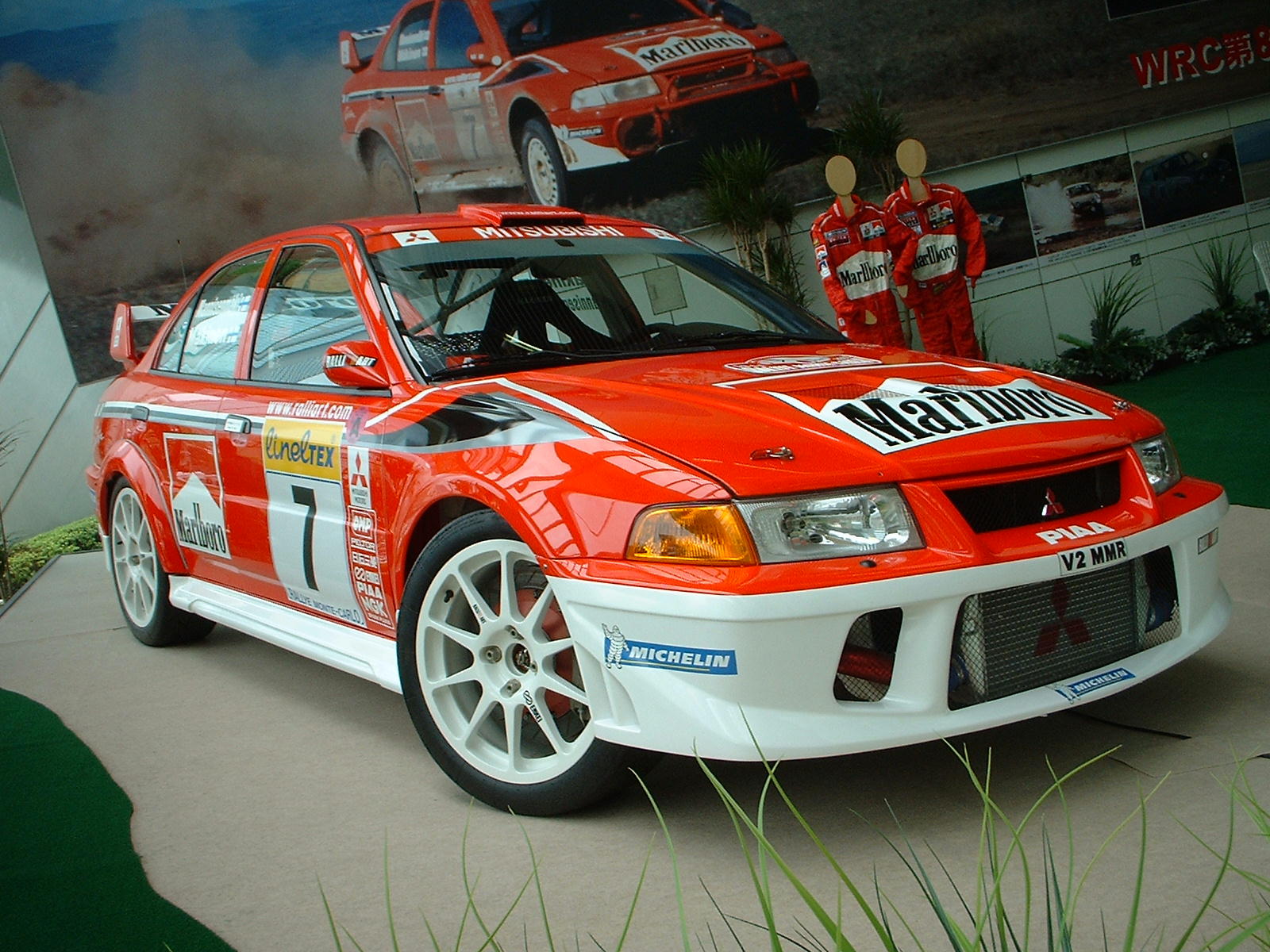
Yet another special edition Evolution VI was released in 1999: the Tommi Mäkinen Edition, named after Finnish rally driver Tommi Mäkinen that had won Mitsubishi four WRC drivers championships.
 It featured a different front bumper, Red/Black Recaro seats (with embossed T. Mäkinen logo), 17" Enkei white wheels, 
a leather Momo steering wheel and shift knob, a titanium turbine that spooled up quicker, front upper strut brace, 
lowered ride height (with tarmac stages in mind), and a quicker steering ratio. Amongst other colours,
 the Evo VI came in either red (Tommi Mak only), white, blue, black or silver with optional special decals, replicating Tommi Mäkinen's rally car's colour scheme.
 This car is also sometimes referred to as an Evolution 6½, Evolution 6.5, or TME for short.


Evolution-VII:(Seventh Generation)


In 2001, Mitsubishi was forced by the FIA to race in the WRC using WRC rules for building a car instead of the Group A class rules, and thus did not need to follow homologation rules. 
The Evolution VII was based on the larger Lancer Cedia platform and as a result gained more weight over the Evolution VI, but Mitsubishi made up for this with multiple important chassis tweaks. 
The biggest change was the addition of an active center differential and a more effective limited-slip differential, while a front helical limited-slip differential was added. 
Torque was increased again to 385 N·m (284 lb·ft) with engine tweaks that allowed greater airflow, and horsepower officially remained at 280 PS (206 kW; 276 hp).
The introduction of the Evolution VII also marked the first time an automatic drivetrain was included within the model lineup—the GT-A.
 Seen as the 'gentleman's express' version of the visually similar VII GSR, the GT-A model was only produced in 2002 and had the following distinguishing interior and exterior specification: GT-A-only diamond cut finish 17-inch (430 mm) alloy wheels, clear rear light lenses and all-in-one style front headlights (later used on the Evolution VIII). The GT-A had the option of either no spoiler, the short spoiler (as later used on the Evolution VIII 260) or the thunderspoiler as used on the standard Evolution VII models. The most distinguishing feature was a smooth bonnet with no air-grills on it at all.
 Although offering inferior cooling capabilities, the bonnet was designed to give a cleaner line through the air with less air resistance at motorway speeds.
Interior could be specified with factory options of a deluxe velour interior, full leather or the Recaro sports seats.
 The GT-A interior was different in that it had chromed door handles, a different instrument panel (to show the gear selection) and chrome edged bezels around the speedo and tach. 
The GT-A also had additional sound deadening installed from the factory and the engine manifold and downpipe had been engineered to be quieter.
The 5-speed automatic gearbox had what Mitsubishi called "fuzzy logic", which meant that the car would learn what the driver's driving characteristics were like and would adapt the gear change timings and kick down reactions accordingly. The gears could be manually selected as with most Tiptronics via steering wheel + and – buttons (a pair both sides) or via selecting the tiptronic gate with the gear lever. Power was down a little from the standard manual cars with 264 PS (194 kW; 260 hp). The GT-A gearbox did not appear again in the Evolution VIII but has been installed in the estate version of the Evolution IX Wagon. It was replaced by the Twin Clutch SST gearbox since the introduction of Evolution X.


Evolution-VIII:(Eighth Generation)

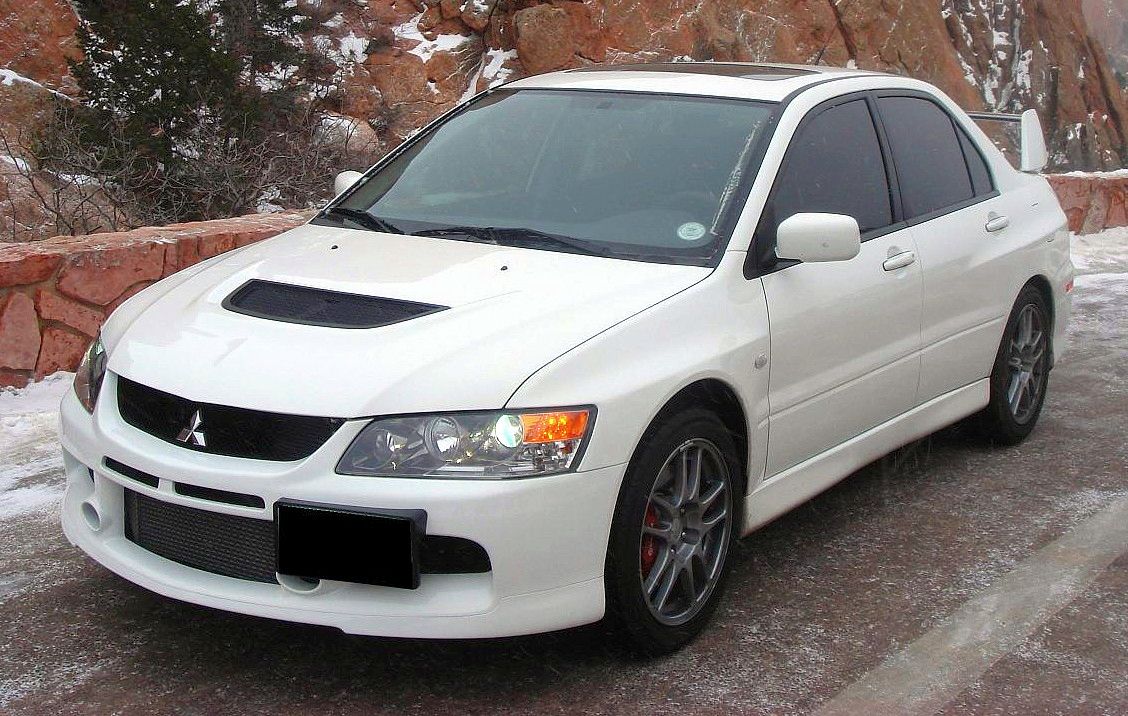
The Evolution VIII was modified again in 2003, this time sporting 17" grey Enkeiwheels, Brembo Brakes and Bilstein shocks to handle traction and a 5-speed manual gearbox with 280 PS (202 kW; 276 hp)(approx. 234 hp to the wheels).
 Originally a one off model, sales were so successful in the U.S. that by 2005 it was available in four trims: the standard GSR model in Japan, the RS, with an aluminum roof, 5-speed gearbox, and standard wheels (lacking excess components, such as interior map lights, power windows/doors, and radio), the SSL (with a sunroof, trunk mounted subwoofer, and leather seats), and the MR, which came with a revised limited-slip front differential, aluminum MR shift knob, handbrake with carbon fiber handle, 17 inch BBS wheels, aluminum roof, and a 6-speed manual gearbox. The new Evolution also sported chrome housing tail lights and head lights.
The Lancer Evolution VIII MR uses slick-response Bilstein shocks for improved handling. The aluminium roof panel and other reductions in body weight have lowered the centre of gravity to produce more natural roll characteristics. Detail improvements have also been made to Mitsubishi’s own electronic four-wheel drive, to the ACD 5 + Super AYC 6 traction control, and to the Sports ABS systems. The Lancer Evolution VIII displayed at the 2003 Tokyo Motor Show took the MR designation traditionally reserved for Mitsubishi Motors high-performance models (first used for the Galant GTO). Other parts on the MR include BBS alloy wheels, the aforementioned Bilstein shocks, and an aluminium roof. In the United Kingdom, many special Evolutions were introduced, including the FQ300, FQ320, FQ340, and FQ400 variants. They came with 305, 325, 345, and 405 hp (227, 239, 254 and 302 kW), respectively. Although Mitsubishi have not confirmed the fact, it is widely rumoured that the FQ stands for "Fucking Quick".
The FQ400, sold through Ralliart UK, produces 411 PS (302 kW; 405 hp) from its 2.0 L 4G63 engine, the result of special modifications by United Kingdom tuning firms Rampage Tuning, Owen Developments, and Flow Race Engines. At 202.9 hp (151.3 kW) per litre, it has one of the highest specific outputs per litre of any roadcar engine. With a curb weight of 1,450 kg (3,197 lb), it achieves 0–60 mph in 3.5 seconds, 0–100 mph in 9.1 seconds, 1/4 mile in 12.1 seconds at 117 mph (188 km/h), and a top speed of 175 mph (282 km/h) while costing £48,000. BBC's television series Top Gear demonstrated that the stock FQ-400 could surprisingly keep up with a Lamborghini Murciélago around a test track. The Stig recorded a Top Gear Power Lap Times of 1 minute and 24.8 seconds, 1.1 seconds slower than the Murciélago's time of 1 minute 23.7 seconds.
In a similar test conducted by Evo magazine, the Evolution was able to lap the Bedford Autodrome faster than an Audi RS4 and a Porsche 911 Carrera 4S.
The Lancer Evolution VIII was also the first Evolution to be sold in the United States,[10] spurred by the success of the Subaru Impreza WRX which had been released there just three years prior. The Evolution VIII found its true competition in the Subaru Impreza WRX STI model the same year as the Evolution VIII's US introduction. However, the internal components for the American versions were largely stripped-down versions of the specifications for the Japanese Lancer Evolution VIII. No US-spec Evolution model prior to the Evo X has active yaw control, including the 2006 Evolution IX. The American 2003 and 2004 GSRs are without the helical limited-slip front differential and 6-speed manual transmission. The 2004 US spec RS models, however, do have a front helical limited-slip differential. All 2003, 2004 and 2005 RS and GSR models have the Japanese Evolution VII's 5-speed transmission. The MR edition was introduced to the US in 2005, with ACD and the only model with a 6-speed transmission. The 2005 US spec RS and GSR have the ACD standard, and the front helical limited-slip differential is now standard on all models. The boost, timing, and tuning are also significantly lower than its Japanese counterpart, allowing it to adhere to the strict emissions regulations of the United States. Starting in 2005, the US model Evos were also fitted with a 5000rpm limit on launching in 1st gear to protect the drivetrain.
Most Evolution VIIIs have a carbon fiber rear spoiler with matching body-color endplates. Furthermore, the US versions of the Lancer Evolution VIII 2003–2005 were given bulkier rear bumpers than their Japanese counterparts to accommodate US safety laws in the form of the metal rear crash bar. All Evos have lightweight aluminum front fenders and hoods. MR and RS editions have an aluminum roof. Additionally, MR Editions come equipped with a 6-speed transmission, Bilstein shocks, and factory optional BBS wheels.
The basic RS Edition does not come with power windows, locks, or mirrors, an audio system, rear wing, sound deadening material, map lamps or an anti-lock braking system. All Evo VIII RS models sold in the US have an air conditioning system.


Evolution-IX:(NInth Generation)


Mitsubishi introduced the Lancer Evolution IX in Japan on March 3, 2005, and exhibited the car at the Geneva Motor Show for the European market the same day.
The North American markets saw the model exhibited at the New York International Auto Show the following month. 
The 2.0 L Mitsubishi Sirius engine#4G63 engine has MIVEC technology (variable valve timing), and a revised turbocharger design boosting official power output at the crankshaft to 291 PS (214 kW; 287 hp) and torque to 392 N·m (289 lb·ft).
The USDM Lancer Evolution IX models: standard (Grand Sport Rally or "GSR" in some markets), RS (Rally Sport), SE (Special Edition) and MR (Mitsubishi Racing) varied slightly in their performance capabilities. Subtleties unique to each model accounted for variations in acceleration, handling and top speed.
 The RS excluded features standard on the standard, SE and MR models (stereo system, power windows and locks, rear wiper, rear wing, trunk lining and sound insulation). The result is a weight savings of over 60 lb (27 kg). The fuel capacity remains the same as the Evo VIII at 14 USgal (53 L).
Although the RS is the lightest of the group, the RS did not manage to outperform the standard IX and the MR around a road course (even if only by fractions of a second). This was purported to be due to the lack of a rear wing on the RS. In a drag race, the three models are all about even. The times for the quarter miles ranged from 13.4 to 13.7 seconds. 
The RS model was produced for rally and racing teams who wanted a platform to build a race car from. It is stripped of all the creature comforts, and other upgrades that drive the price up for features that the race teams would not require.
The IX MR retained the features of the Evolution VIII MR, like Bilstein shocks, a 6-speed manual transmission, a rooftop vortex generator, BBS forged wheels, HID xenon headlights, foglights, accessory gauge package, "zero lift" kit, special badging and an aluminum roof. All models continued to sport Recaro bucket seats, Brembo brakes and Momo steering wheels. 
Additional revisions from 2005 included a closer gear ratio for the 5-speed manual transmission, new lighter Enkei wheels on non-MR models, a redesigned front end with a more efficient air dam (the most noticeable feature are the two small oval ducts to cool the intercooler pipes), and a new rear bumper with a diffuser undersurface to smooth out the airflow coming out of the car for non-US models. 
In an effort to reduce the price increase on the Evolution IX model,[citation needed] HID headlights were no longer standard equipment on the base IX (nor were they standard on the 2005 VIII), and were available only in the SSL package (Sun, Sound, and Leather), SE (Special Edition) and MR trims.
The US versions of the Lancer Evolution IX did not come with the AYC but the ACD was still present. The drivers can select from three different driving modes, "Tarmac" "Gravel" and "Snow", and the car's computer system relatively promotes the active center differential to change the differential locking which, eventually changes the front/rear power distribution to increase traction, thus providing an optimum driving experience. 
Although the US versions did not come with the AYC, it did come with a rear 1.5way clutch type LSD (limited slip differential)which, limits the slip from both rear wheels causing less traction loss of the rear wheels. The most common setup is the 1.5 way LSD, locking on throttle and partially locking on braking. In racing, Lancer Evolutions are not equipped with AYC or ACD because it is believed that better lap times are achieved by pure driver skill without any computer based assistance systems.
One of the changes from the previous iteration of the Lancer Evolution, was the change in the engine, the new 4G63 came with MIVEC, Mitsubishi's variable valve lifting technology, which drastically improves the fuel consumption by changing the valve timing on the intake cam. The MIVEC system is similar to Honda's i-VTEC system only that it doesn't change valve lift, only intake valve timing.
Three trims were available for Japan, Asia and Europe. Although all models used the same 291 PS (214 kW; 287 hp) engine, the torque differed from one model to another. In Europe, however, the Evolution IX was advertised to have 280 PS (206 kW; 276 hp). The GSR produced 400 N·m (295 lb·ft) of torque, while the RS and GT produced 407 N·m (300 lb·ft).
RS – "rally sport", revised 5-speed, aluminium roof, gauge pack, minimal interior, LSD and a titanium-magnesium turbine, left-hand drive option available.
MR RS – same as RS with 6-speed Manual Transmission.
GT – revised 5-speed, this is basically the RS mechanically, but with some of the GSR's features (mainly interior pieces).
GSR – 6-speed, Bilstein monotube shocks, aluminium roof, gauge pack, SAYC (Super Active Yaw Control), and double-din radio (this is roughly equivalent to the USDM MR).
MR GSR – same as GSR with BBS 17-inch alloy wheels.
MR Tuned by RALLIART – Based on Lancer Evolution VI Tommi Makinen Edition, The Japanese Lancer Evolution IX was exclusively tuned by Mitsubishi Ralliart features the almost same as the civilian Evo IX MR GSR except for Carbon Fiber front lip Spoiler, Official Ralliart livery, Ralliart RA04 17-inch Black forged aluminum wheels.
In the United Kingdom, the Evolution IX used a different model scheme based on the car's horsepower. There were initially three models available: the FQ-300, FQ-320 and FQ-340 each with around 300(296/221), 320(316/236) and 340(336/250) PS(BHP/KW) respectively. 
An FQ-360 model was subsequently released as a successor to the Evolution VIII FQ-400. While the new FQ-360 produced less horsepower than its predecessor, it had more torque at 363 lb·ft (492 N·m) at 3200 rpm. 
All four models were designed to run on super unleaded petrol only. The MR FQ-360 was also released in limited numbers (only 200) in the last year of production.
FQ-300, 320, 340 – 6-speed, Bilstein monotube shocks, AYC (Active Yaw Control), super unleaded petrol only
FQ-360 – 6-speed, Bilstein monotube shocks, AYC (Active Yaw Control), Ralliart Sports Meter Kit, carbon front splitter, Speedline alloy wheels, super unleaded petrol only
MR FQ-360 – New turbo with titanium aluminium alloy turbo fins, Speedline Turini alloy wheels, Privacy Glass, Lowered Eibach Coil springs (10mm at the front/ 5mm at the rear), IX MR interior, super unleaded petrol only
Four models were available in the US. All models used the same 286 hp (213 kW) engine.
Standard – revised 5-speed, standard model
RS – ralli sport, revised 5-speed, aluminum roof, gauge pack, minimal interior, also no radio
SE – Special Edition, aluminum roof/hood, and front fenders, split seven-spoke forged aluminum BBS wheels in "diamond black" finish, HID headlights with integrated fog lights, red-stitched Recaro seats
MR – 6-speed, Bilstein monotube shocks, split seven-spoke forged aluminum BBS wheels, aluminum roof, hood, and front fenders, gauge pack, HID headlights with integrated fog lights, vortex generator, front brake cooling ducts and custom MR badging.
All of the American models are the same in power, but may differ in performance. The only thing that sets them apart is the Evo RS, which is 80 lb (36 kg) lighter than the MR and SE models.
To the standard model, the Sun, Sound and Leather package added a power sunroof, HID xenon headlamps with integrated fog lights, a slightly different stereo headunit (with no integral amplifier), slightly upgraded speakers in the front doors and parcel shelf, a 4.1-channel amplifier under the driver's seat, a powered, trunk-mounted Infinity subwoofer, black leather seating surfaces, leather-trimmed door panels, slightly revised center armrests in the front and rear, and separate rear side headrests. This model deleted the GSR's headliner-mounted sunglass holder to make room for the sunroof.
The Philippines had the Evolution IX until in August 2008, which was offered in two trims, the entry-level RS offering a 5-speed manual transmission, Brembo 17-in. ventilated discs (4-Pot), Brembo 16-in ventilated drum-in-disc (2-Pot) and almost the same features as to that of the GSR trim in the international version. Some RS models had the SAYC option, while some did not. The MR was the top-of-the-line segment, which offers almost the same feature as to that of the MR trim in the international version. All of them are powered by a l4 2.0 4G63 turbocharged MIVEC engine.


Evolution X:(Tenth Generation)


In 2005, Mitsubishi introduced a concept version of the next-gen Evolution at the 39th Tokyo Motor Show named the Concept-X, designed by Omer Halilhodžić at the company's European design centre.
Mitsubishi unveiled a second concept car, the Prototype-X, at the 2007 North American International Auto Show (NAIAS).
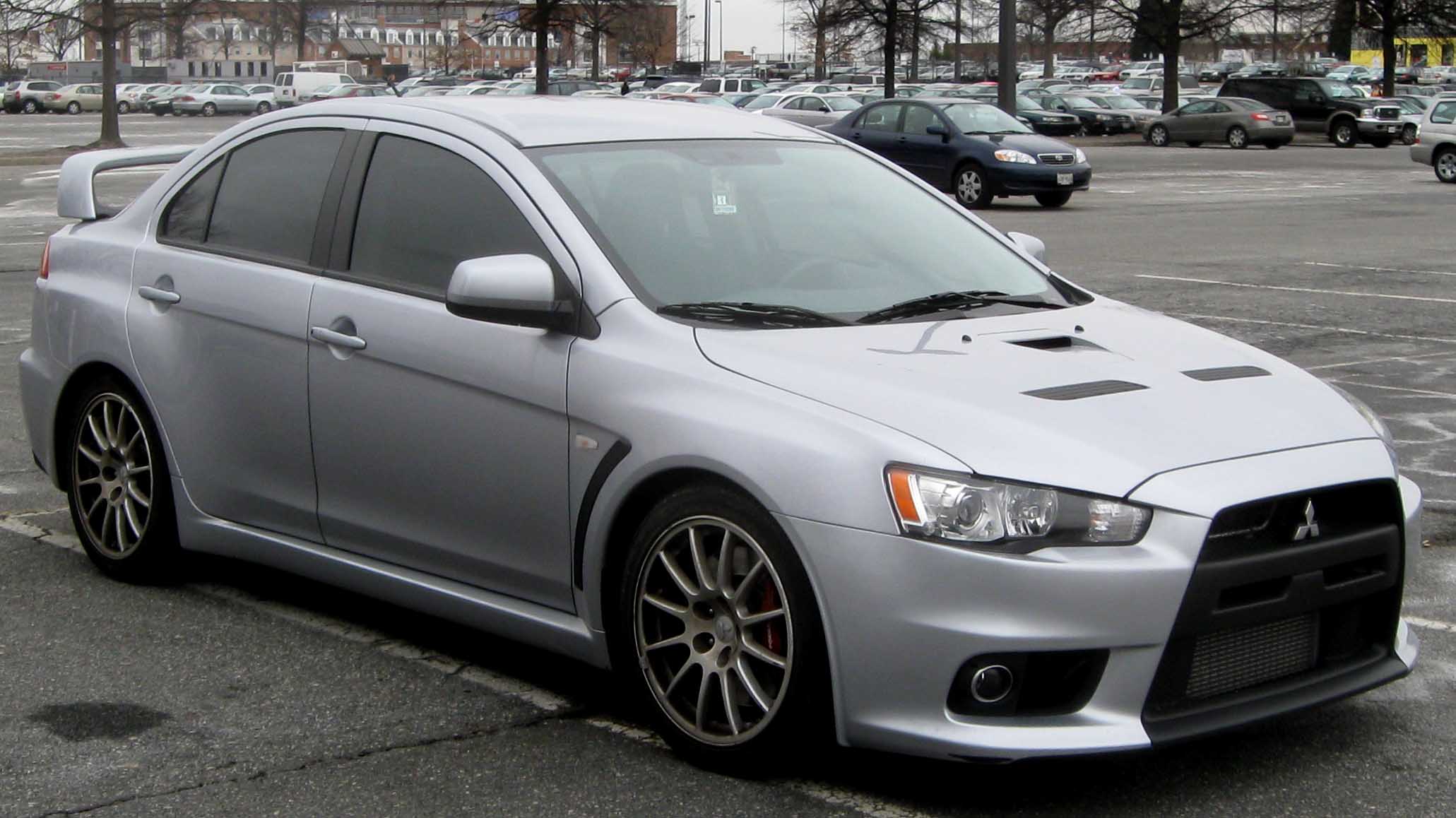
The Lancer Evolution X sedan features a newly designed 4B11T 2.0L (1998cc) turbocharged, all-aluminium inline-4 GEMA engine. Power and torque depend on the market but all versions will have at least 280 PS (206 kW; 276 hp). (JDM version), the American market version will have slightly more. The UK models will be reworked by Mitsubishi UK, in accordance with previous MR Evolutions bearing the FQ badge. Options for the UK Evolutions are expected to be between 300 hp (220 kW) and 360 hp (270 kW).
Two versions of the car will be offered in the U.S. The Lancer Evolution MR, with 6-speed Twin Clutch Sportronic Shift Transmission (TC-SST). The other version is the GSR which will have a 5-speed manual transmission system. The car also has a new full-time four-wheel drive system named S-AWC (Super All Wheel Control), an advanced version of Mitsubishi's AWC system used in previous generations.The S-AWC uses torque vectoring technology to send different amount of torque to any wheel at any given time.
It also features Mitsubishi's new sequential semi-automatic six speed SST twin-clutch transmission with steering-mounted magnesium alloy shift paddles. It has replaced the Tiptronic automatic transmission, hence the SST version replaced the GT-A version (which was used in Evolution VII and Evolution IX Wagon). A five speed manual gearbox will also be available. Mitsubishi claims that the five speed manual transmission has always been preferred in rallying and should be very refined, resulting in a more satisfying drive.New Lancer Evolution will incorporate Mitsubishi's next generation RISE safety body.
The Evolution X went on sale October 1, 2007 in Japan, January 2008 in the USA, February in Canada (as the first version of Evolution in Canada) and in March 2008 in the UK. The Twin Clutch SST version was available in Japan from November 2007. Europe will follow with sales in May, GSR and MR version included premium Package.
The introduction of the 2010 MR-Touring moved the car even further upscale. Leather and a Moonroof became standard while revising the rear spoiler to just a lip spoiler


Toyota Land Cruiser


The Toyota Land Cruiser (Japanese: トヨタ ランドクルーザー Toyota Rando-kurūzā?) is a series of four-wheel drive vehicles produced by the Japanese car maker Toyota Motor Corporation.
The Land Cruiser series is the longest running series in Toyota history.
Development of the first generation Land Cruiser began in 1951 as Toyota's version of a Jeep-like vehicle and production started in 1954.
The Land Cruiser has been produced in convertible, hardtop, station wagon, and utility truck versions.
 The Land Cruiser's reliability and longevity has led to huge popularity, especially in Australia where it is the best-selling full-size,
body-on-frame, four-wheel drive vehicle.
Toyota also extensively tests the Land Cruiser in the Australian outback — considered to be one of the toughest operating environments in both temperature and terrain.
 Main rivals include the Range Rover, Land Rover Discovery, Mitsubishi Pajero and Nissan Patrol.


20 Series:


1955 — The Second generation, 20 Series was introduced. It was designed to have more civilian appeal than the BJ for export reasons.
 It also had more stylish bodywork and a better ride thanks to longer four-plate leaf springs which had been adapted from the Toyota Light Truck.
 It had a more powerful 135 PS (99 kW) 3.9 L six-cylinder Type F gasoline engine, but still only had a three speed gearbox. The interior of the vehicles were made more comfortable by moving the engine 120 mm (4.7 in) forward.
The 20 Series still had no low range, but it had synchromesh on the third and fourth gears.
1958 — The first Station wagon Land Cruiser was introduced with an even longer 2,650 mm (104.3 in) wheelbase (the FJ35V; wagon and van).
 The FJ25 production started in Brazil being the first Toyota vehicle built outside Japan.
1957 — A 4-door Station Wagon was added as the FJ35V. Land Cruisers were first imported into Australia by B&D Motors as FJ25/28 cab chassis with Australian made bodies.
 They were the first Japanese cars to be regularly exported to the countryand a few were initially used in the Snowy Mountains Hydroelectric Scheme, by sub contractor Theiss Constructions


40 Series:


.
1965 — Global production surpassed 50,000 vehicles.
The Land Cruiser was the best selling Toyota in the United States.
1968 — The 100,000th Land Cruiser was sold worldwide.
1972 — The 200,000th Land Cruiser was sold worldwide.
1973 — The 300,000th Land Cruiser was sold worldwide.
The first diesel Land Cruiser was introduced for export on long wheelbase models with a six-cylinder H engine
1974 — A four-cylinder 3.0 L B diesel was offered. The introduction of this engine boosted sales in Japan by putting the Land Cruiser in a lower tax compact Freight-car category than its 3.9 L gasoline version. Note: the new B diesel engine was different from the B gasoline engine used in the original BJ.
1975 — The 3.9 L gasoline engine was replaced by a larger, more powerful 4.2 L 2F unit.
The FJ55 received front disc brakes.
The 3.6 L H diesel engine was optional in some markets in the HJ45.
1976 — United States-version FJ40 Land Cruisers received front disc brakes like the FJ55.
The Toyota Land Cruiser Association was founded in California.
1977 — The Irish Army took delivery of the first of 77 FJ45 Land Cruisers. Although fast, reliable and with good off-road performance the type tended to rust excessively in the wet Irish climate. A few which did not succumb to the effects of weather were repainted in gloss olive green and survive as ceremonial gun tractors at military funerals.
1978 — The first BJ / FJ40 and FJ55 models were officially sold in West Germany with both diesel (BJ40) and petrol engines (FJ40 /55).
1979 — United States-version FJ40s were updated this year with a new wider, square bezel surrounding the headlights.
Power steering and cooler were offered in FJ40s for the first time.
The diesel engine was improved, evolving into the 3.2 L 2B only in Japan.
1980 — The H diesel engine (HJ45) was replaced by the 4.0 L 2H engine (HJ47).
1981 — the Diesel version received front disc brakes and the more powerful 3.4 L 3B engine, and added LWB BJ45 with 3B.
1983 — the last FJ40s imported to the U.S. were 1983 models (mid 1982 to mid 1983). It is unknown how many were imported by Toyota, but many guess the number to be around 300. 1983 FJ40s typically bring a premium for their rarity, though they are not much different from 1982 models (mid 1981 to mid 1982).


Saturday, 17 November 2012

Toyota Corolla


The Toyota Corolla is one of a line of subcompact and compact cars manufactured by the Japanese automaker Toyota, which has become very popular throughout the world since the nameplate was first introduced in 1966. In 1997, 
the Corolla became the best selling nameplate in the world, surpassing the Volkswagen Beetle.
 Over 39 million Corollas have been sold as of 2012. The series has undergone several major redesigns.
he name "corolla" is part of Toyota's naming tradition of using the name Crown for primary models: the Corona, for example, gets its name from the Latin for crown; Corolla is Latin for small crown; and Camry is an Anglicized pronunciation of the Japanese for crown, kanmuri.
 The Corolla has always been exclusive in Japan to Toyota Corolla Store locations, and manufactured in Japan with a twin, called the Toyota Sprinter, sold at a specific Japanese Toyota dealership called Toyota Auto Store, then renamed Toyota Vista Store in 1980.

Corollas are manufactured in Japan and in Brazil (Indaiatuba, São Paulo), Canada (Cambridge, Ontario), China (Tianjin), India (Bangalore), 
Indonesia, Malaysia, Pakistan, Philippines, South Africa (Durban), Taiwan, Thailand, Turkey and Venezuela. 
Production has previously been made in Australia (Victoria) and the United Kingdom (Derbyshire).
 Production in the United States (at NUMMI in Fremont, California) ended in March 2010.


Alternative versions
There have also been several models over the years, including the Corolla Ceres (and similar Sprinter Marino) hardtop, Corolla Levin and Sprinter Trueno sports coupés and hatchbacks,
 and the Corolla FX hatchback, which became the Corolla RunX, while the Sprinter became the Allex, with the introduction of the ZZE128 Corolla.
 The RunX and Allex was replaced by the Auris in 2006 (known only as Corolla in markets outside of Japan).
 A luxury version of the Auris installed with V6 engines was briefly sold at Japanese Toyota dealerships Toyota Store and Toyopet Store locations as the Blade, which was discontinued in 2012.
A compact MPV named the Corolla Verso has also been released in European markets. 
Its Japanese counterpart is the Corolla Spacio, which has been discontinued as of the 10th generation. The Corolla Rumion is also sold in the US-market as the Scion xB.

The Corolla Matrix, better known just as the Matrix, shares the E120 and E140 platforms, 
and is considered the hatchback/sport wagon counterpart of the North American Corolla sedan, 
as the European/Australasian Corolla hatchback is not sold there. Toyota frequently combines the sales figures of the Corolla sedan and Matrix.
 The Pontiac Vibe, which is the General Motors badged version of the Matrix, also shares the Corolla platform.
 The Pontiac Vibe was exported from Fremont, California to the Japanese market where it was badged Toyota Voltz.

First generation (E10):

The first Corolla generation was introduced in October 1966 with the new 1100 cc K pushrod engine. The Corolla Sprinter was introduced as the fastback version in 1968, and exclusive to a Toyota Japan dealership retail outlet called Toyota Auto Store.


Second generation (E20):


In May 1970, the E20 was restyled with a more rounded body and the 1400 cc T and 1600 cc 2T OHV engines were added to the range.
 The now mutually exclusive Corolla and Sprinter names were used to differentiate between two slightly different treatments of sheet metal and trim. 
The Corolla Levin and Sprinter Trueno names were introduced as the enhanced performance version of the Corolla and Sprinter respectively when a double overhead camshaft version of the 2T engine was introduced in March 1972.


Third generation (E30, E40, E50, E60):


April 1974 brought rounder, bigger and heavier Corollas and Sprinters. The range was rounded out with the addition of a two-door liftback. 
The Corollas were given E30 codes while the Sprinters were given E40 codes.
 A face-lift in March 1976 saw most Corolla E30 models replaced by equivalent E50 models and most Sprinter E40 models were replaced by equivalent E60 models.


Fourth generation (E70):


A major restyle in March 1979 brought a square edged design. The Corollas had a simpler treatment of the grill, headlights and taillights while the Sprinter used a slightly more complex, sculptured treatment. The new A series engines were added to the range as a running change. 
This was the last model to use the K "hicam" and T series engines. Fuel injection was introduced as an extra cost option on Japanese market vehicles.


Fifth generation (E80):


A sloping front bonnet and a contemporary sharp-edged, no-frills style was brought in during May 1983. 
The new 1839 cc 1C diesel engine was added to the range with the E80 Series. From 1985, re-badged E80 Sprinters were sold in the U.S. as the fifth generation Chevrolet Nova. 
Fuel injection was introduced as an extra cost option internationally.
Most models now used the front wheel drive layout except the AE85 and AE86, which were to be the last Corollas offered in the rear wheel drive or FR layout. 
The AE85 and AE86 chassis codes were also used for the Sprinter (including the Sprinter Trueno). The Sprinter was nearly identical to the Corolla, differing only by minor body styling changes such as pop-up headlights.


Sixth generation (E90):


A somewhat more rounded and aerodynamic style was used for the E90 introduced in May 1987.
 Overall this generation has a more refined feel than older Corollas and other older subcompacts.
 Most models were now front wheel drive, along with a few 4WD All-Trac models.
 Many engines were used on a wide array of trim levels and models, ranging from the 1.3 liter 2E to the 165 horsepower (123 kW) supercharged 4A-GZE.
 The E90 Sprinter was also rebadged and sold as the Geo Prizm (US) or Holden Nova (Australia).


Seventh generation (E100):


In June 1991 Corollas received a redesign to be larger, heavier, and have the completely rounded, aerodynamic shape of the 1990s.
 In the United States, the somewhat larger Corolla was now in the compact class, rather than subcompact, and the coupé was still available in some markets,
 known as the AE101 Corolla Levin. Carburetors were mostly retired with this generation.


Eighth generation (E110):


May 1995 saw a complete redesign for the Corolla. Evolutionary technological improvements continued, however, and in 1998, for the first time,
 some non-Japanese Corollas received the new 1ZZ-FE engine.
 The new engine was the first in a Toyota to have an aluminum engine block and aluminum cylinder heads, which made this generation lighter than the E100 Corolla.
 The model range began to change as Toyota decided styling differences would improve sales in different markets. This generation was delayed in North America until mid 1997 (US 1998 model year), where it had unique front and rear styling
.
Europe and Australasia received versions of their own as well.


Ninth generation (E120, E130):


In November 2000, the ninth-generation Corolla was introduced in Japan, with edgier styling and more technology to bring the nameplate into the 21st century. 
It is also called the Corolla Altis in the ASEAN region. The station wagon model is called the Corolla Fielder in Japan. 
The North American release was delayed until March 2002 (2003 MY).


Tenth generation (E140,E150):


The tenth generation of the Corolla was introduced in October 2006. Japanese markets called it the Corolla Axio, with the ASEAN markets retaining the Corolla Altis branding.
The station wagon retains the Corolla Fielder name.
The Corolla Altis and Corolla Axio have a different appearance. The North American release was delayed until January 2008 (2009 MY).


Eleventh generation (E160):


The eleventh generation of the Corolla went on sale in Japan in May 2012.
The sedan is named the Corolla Axio while the wagon is called the Corolla Fielder.
In Japan, both are made by a Toyota subsidiary, Central Motors, in Miyagi prefecture, Japan.
 The redesigned model has slightly smaller exterior dimensions and is easier to drive in narrow alleys and parking lots for the targeted elderly consumers.

The new Corolla Axio is available with either a 1.3-liter 1NR-FE or 1.5-liter 1NZ-FE four cylinder engines; front or all-wheel drive.
 Both 5-speed manual and CVT transmissions are offered. The 1.3-liter engine and all-wheel drive variants are available only with the CVT transmission.
 The Corolla Fielder is available with 1.5-liter 1NZ-FE or 1.8-liter 2ZR-FAE four cylinder engines mated with a CVT transmission.
 The 1.5-liter is available with front and all-wheel drive, the 1.8-liter is offered only in front-wheel drive.

Welcome .........

Welcome On Board Fellas !!!
Its Time To know About The Beasts Which You Cruise On ............. 
This Blog is All About Rides And Their Origins'